
computational tools for

cancer spheroid models

Over the past decades, three-dimensional tumor spheroids and organoids - so called tumoroids - have emerged as promising and physiologically relevant preclinical models. Unlike traditional two-dimensional culture systems, tumoroids preserve key aspects of the cellular heterogeneity and the three-dimensional spatial organization of human tumors. This provides a platform to investigate questions related to tumor architecture, treatment response and resistance mechanisms under controlled conditions.

image
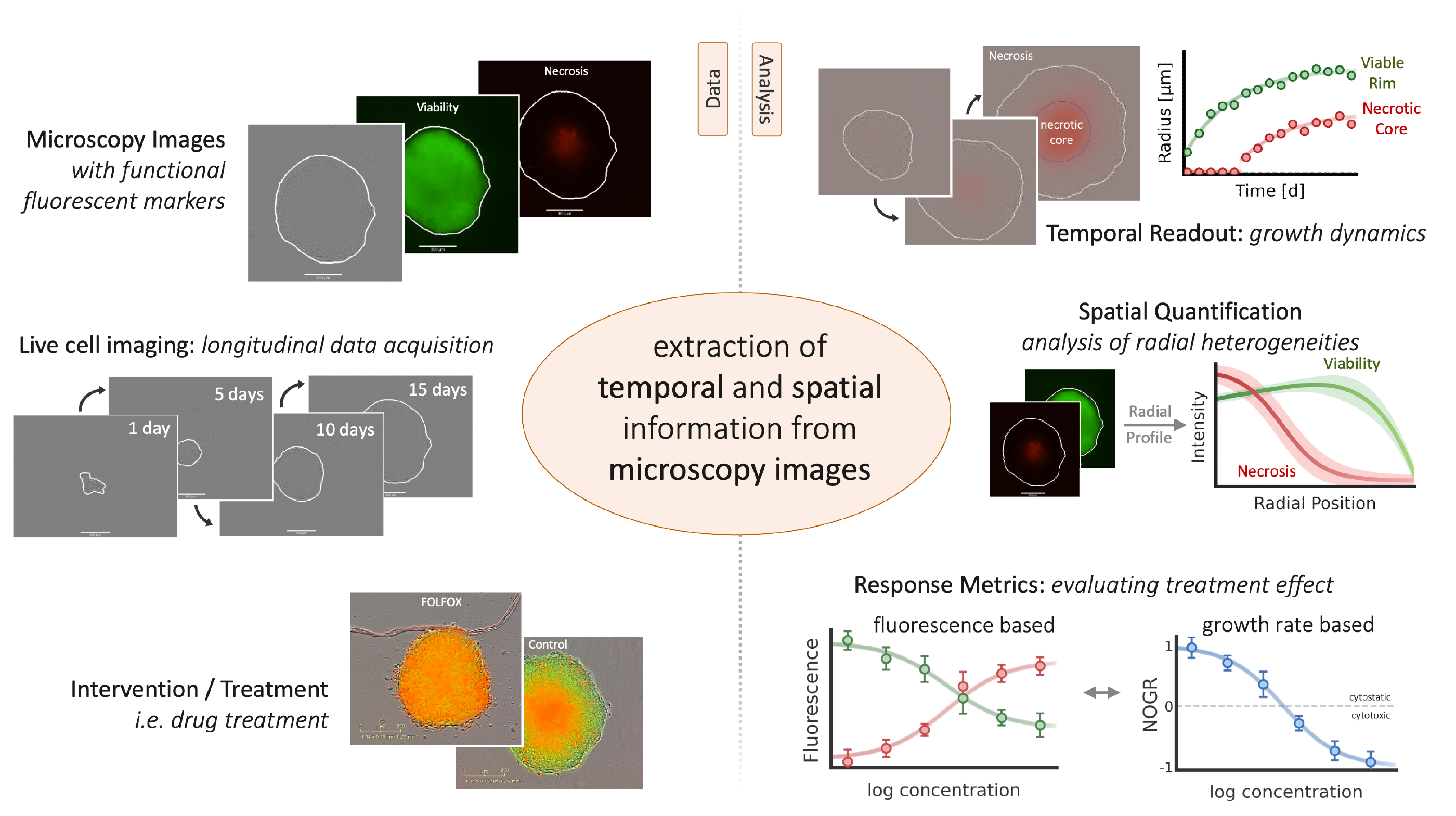
Extraction of temporal and spatial information from spheroid microscopy images. Live-cell imaging is a common tool in spheroid experiments, as it can yield a high spatial and temporal resultion with the possibility for functional markers using fluorescence (left). Our tool SpheroidPy allows for an easy data loading, image segmentation and feature analysis of large imaging datasets and quantification of both spatial and temporal features (right).

Tumor spheroids and tumoroids offer a unique opportunity for quantitative, biophysical research. Their controlled setting, combined with the three-dimensional architecture, makes them ideally suited for the application of advanced live-cell imaging, automated image analysis and computational modeling approaches that capture the spatial organization and temporal dynamics.

Therefore, we have developed a computational framework to incorporate quantitative analysis into experimental workflows and data processing. It aims to enhance the extraction of information from imaging data and provide user-friendly access to growth metrics and spatial features.


more  


Software
To enhance the quantitative analysis of three-dimensional cancer cell assays, we have developed a dedicated software package combining relevant tools into a unified framework. More information can be found below or on our GitHub page. For questions, feedback or feature requests, please feel free to contact us.
SpheroidPy

SpheroidPy

A Python Package for the Analysis of Spheroid Microscopy Data.

more  
GitHub

GitHub

For more information and tutorials on our software follow us on GitHub.

more  
SpheroidPy

SpheroidPy

A Python Package for the Analysis of Spheroid Microscopy Data.

more  
GitHub

GitHub

For more information and tutorials on our software follow us on GitHub.

more  

Open Source Principles

Since our software builds upon established theoretical models as well as open-source packages, we are committed to making our own packages available open source.

Transparency

All parts of our software are documented and will be openly accessible, ensuring full transparency of methods, data, and code.

Maintenance

Our software is actively maintained, with updates and fixes to ensure reliability, reproducibility, and long-term usability.

Contribution

Researchers and developers are encouraged to contribute, extending functionality, improving documentation, or suggesting enhancements.

Distribution

Our software is distributed under an open-source license, enabling free use and sharing within the scientific community.


Transparency

All parts of our software are documented and will be openly accessible, ensuring full transparency of methods, data, and code.

Maintenance

Our software is actively maintained, with updates and fixes to ensure reliability, reproducibility, and long-term usability.

Contribution

Researchers and developers are encouraged to contribute, extending functionality, improving documentation, or suggesting enhancements.

Distribution

Our software is distributed under an open-source license, enabling free use and sharing within the scientific community.